
Happy Birthday RECs!
This month marks the 4th birthday of the Regional Extension Center (REC) Program, and what a four years it’s been! We thought we’d take this chance to talk about some of the accomplishments that REC’s achieved in the past few years, and how their partnership with providers continues in leveraging health IT to improve care.
According to the Centers for Disease Control and Prevention’s National Center for Health Statistics, the percent of physicians using an advanced EHR system was just 28 percent in 2010. In 2009, about one in five physicians used a basic EHR, and EHR adoption rates lagged even further among physicians in small practices with fewer than ten physicians, physicians in rural areas, and other providers who disproportionately care for the underserved. Now, more than 50 percent of eligible professionals have demonstrated meaningful use and received an incentive payment as part of the Medicare and Medicaid EHR Incentive Payment Program which is administered by the Centers for Medicare & Medicaid Services (CMS).
For hospitals, just nine percent had adopted EHRs in 2008, but today, more than 80 percent have demonstrated meaningful use of EHRs.
Select image for larger view
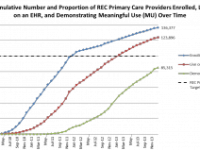
RECs have played a critical role in this transformation, working with over 136,000 (nearly half) of the nation’s primary care providers (PCPs), helping 90 percent (over 123,000) of those providers adopt an EHR system and 62 percent (over 85,000) demonstrate stage 1 meaningful use.
RECs have far exceeded their goal to support the adoption and use of health IT by 100,000 small practices, community health centers, and rural and public hospitals, and while continuing to support providers to reach meaningful use, are now focusing their efforts on helping these health care providers use the technology for care delivery transformation and improvement.
In addition to nearly half of the nation’s 300,000 total PCPs being partnered with an REC (44 percent), REC penetration is even higher for rural PCPs (53 percent), Federally Qualified Health Centers (FQHC) and FQHC Look-Alikes (83 percent) and critical access hospitals (CAHs, 78 percent). Across these settings, EHR adoption ranges from a high of 93 to a low of 84 percent, and meaningful use ranges from 41 to 47 percent.
RECs are also involved in CMS’ Center for Medicare and Medicaid Innovation practice transformation and delivery system redesign efforts: 53 percent of Comprehensive Primary Care Initiative sites and 82 percent of the Medicare FQHC Advanced Primary Care Practice Demonstration Programs are partnered with an REC. Additionally, RECs support over 10,000 specialists committed to health IT adoption and meaningful use. A recent study found providers working with RECs were 1.9 times more likely to have received incentive funds through the EHR incentive program.
Leveraging the REC Investment
RECs have demonstrated tremendous results in assisting providers with adoption and MU of EHRs. However, to effectively use health IT to improve health, healthcare, and to help control costs, it will require continued hard work, focus and support. Building on lessons learned with MU of EHRs, RECs are <a class="colorbox" rel="nofollow" target="_blank" …read more

