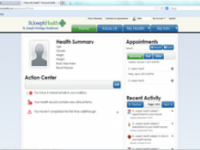

As more and more physicians’ offices and other providers begin to take the first step in setting up a patient portal, I thought it would be interesting to tell our story about how our office implemented and uses a portal. The lessons we learned may be helpful for you as Meaningful Use Stage 2 deadlines for patient portal use approach. And we would love to connect with others who have tackled and solved similar situations.
Dr. Gilbert’s practice recognized early on that a patient portal can spur communications between doctors and patients.
Our organization – 75 providers in Orange County, Calif.-based St Joseph Heritage Medical Group and 150 providers in our sister organization, St. Jude Heritage Medical Group, have been fully implemented on Allscripts Enterprise E.H.R. since 2005. Early on, we recognized the value of a secure patient portal that could spur online communication between us and our patients. Our first two portals, allowed patients to communicate securely with providers and allowed patients to develop a personal health record. Initial obstacles to success mainly centered on provider reluctance to adopt online patient communications. Providers were terrified that, like e-mail, the volume of messages would sky rocket.
To address some of those concerns, our initial efforts were educational. We looked at published data and the personal experience of a small group of providers to dispel the notion of overuse by patients, and promote the positive aspects of online patient communication – namely the ability to respond to patients asynchronously, when it was convenient for providers. It was easier, quicker and more complete than the telephones we were all used to using for patient communication. Providers who embraced this message actively engaged their patients and actively promoted registering for the portal. We were pleased with the adoption of the portal for this core group of providers, but sought to expand registration to include patients from all providers. We decided to incentivize registration, providing specific monetary bonuses for providers who achieved 50 and then 100 registrations in a year. The lesson learned in this initial phase was two-fold – incentives helped, but were no substitute for provider promotion of the portal to patients.
Periodically we solicited feedback from patients about our portal. In this initial phase, patients especially liked the ease of contacting providers on their time. They enjoyed the ability to author a question at night or early in the morning, when the kids were in bed, or before work. With the expectation that they would receive a response they could read later that day. In later deployments of subsequent portals, patients enjoyed the 24-hour access to important parts of their medical record, and the portability of that record. Patients expressed delight when they realized they could review, scan, print or transmit their lab results back to 2005, or confirm the date of their flu vaccine, or children’s school aged vaccines.
About a year or so after our initial roll out, the original provider of the portal sold to another company, and Allscripts, our EHR vendor, …read more
Leave a Reply
You must be logged in to post a comment.